Women In Service - World war I
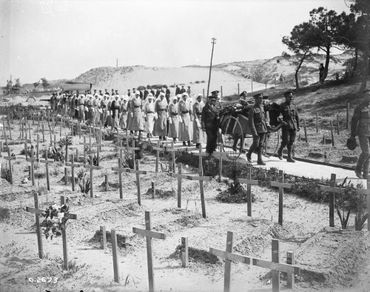
Canadian women's first military contributions were as nurses who tended to the sick and wounded in times of conflict . They were called "Nursing Sisters" because they were originally drawn from the ranks of religious orders. More than 2,800 Canadian Nursing Sisters served with the Canadian Army Medical Corps during the First World War, often close to the front lines of Europe and within range of enemy attack. With their blue dresses and white veils, they were nicknamed the "bluebirds" and were greatly respected because of their compassion and courage. Canadian women were not permitted to serve in other military roles during the First World War.
When women chose to enlist in the military, they also volunteered to potentially put themselves in dangerous situations where their lives were on the line. Canada's nursing sisters in particular found themselves in peril, as they often served in field hospitals close to the fighting.
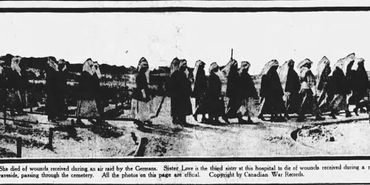
At least 58 nursing sisters died during the First World War — 21 of them from direct enemy action. Six nurses were killed when No. 1 Canadian General Hospital and No. 3 Canadian Stationary Hospital were bombed in France in May 1918. When a German U-boat torpedoed and sank the Canadian hospital ship Llandovery Castle in June 1918, all 14 nursing sisters perished. Another nursing sister died when a German U-boat sank the RMS Leinster in October 1918. Others died from illness and diseases related to their wartime service.
Among those who served, they received nine Military Medals, 317 Royal Red Cross awards, one Royal Victorian Order, and 169 Mentioned in Despatches citations. Two matrons received the Order of the British Empire. More than 50 also received additional foreign decorations.
In addition to Nursing Sisters, women played a role in the Canadian merchant navy, pioneers working as stewardesses. Very little is known of their backgrounds or their lives, and more research is needed to discover their personal and professional histories. Often, only their names, ships, and lengths of service at sea are available in the records. In part, this lack of information may be due to the fact that many of these women had their lives cut short before they could establish homes and families of their own, and so there are no direct descendants interested in tracing the past.
The Langford municipality on Vancouver Island, commemorated women mariners lost in action. In 2002, a large gazebo, the first and only free-standing memorial to women mariners in Canada, was dedicated to their memory at Langford’s Veterans Park. Three women who served during WWI are honoured at the Langford memorial:
Eliza Kennedy
stewardess aboard the S.S. Hesperian – killed September 4, 1915;
Jane Johnstone
stewardess aboard the S.S. Missanabie – killed September 9, 1918;
Elizabeth Oliphant
stewardess aboard the S.S. Missanabie – killed September 9, 1918;
For more information about the contribution of the women of Canada in service and a list of women who paid the ultimate sacrifice please visit the following websites:
1. Veterans Affairs website - Lest We Forget Her: Canadian women who have died in service at https://veterans.gc.ca/en/remembrance/those-who-served/women-veterans/fallen
2. CFB Esquimalt Naval Military Museum website - Merchant Marine Women at https://navalandmilitarymuseum.org/archives/articles/unsung-women/merchant-marine-women/
3. The Canadian Encyclopedia - Canadian Army Medical Corps Nursing Sisters at https://thecanadianencyclopedia.ca/en/article/canadian-army-medical-corps-nursing-sisters
The Bluebirds