

Women in service - world war ii
During the Second World War, more than 50,000 Canadian women enlisted in uniform, and over one million worked on the home front. They freed up men for front-line combat by serving in military branches, medical corps, factories, and farms.
Women in Uniform
Women served across three main military divisions and the medical corps:
- Nursing Sisters: Approximately 4,480 to 4,500 trained nurses served in the Royal Canadian Army Medical Corps, the Royal Canadian Air Force (RCAF) Medical Branch, and the Royal Canadian Naval Medical Service. They were the first Allied military nurses to hold officer rank, and over two-thirds served overseas in field hospitals, general hospitals, and hospital ships.
- Female Physicians: For the first time, around 60 female doctors served as commissioned officers, working as anesthetists, radiologists, and bacteriologists.
- Canadian Women's Army Corps (CWAC): Authorized in 1941, over 21,600 women joined the CWAC as drivers, mechanics, cooks, switchboard operators, signallers, and anti-aircraft range-finders. More than 3,000 served overseas in Britain, Italy, and Northwest Europe.
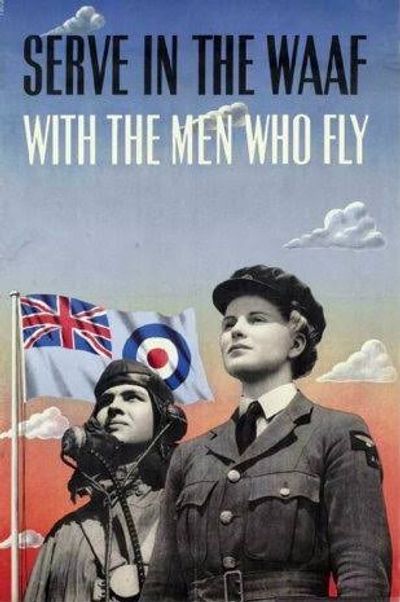
- RCAF Women’s Division (RCAF-WD): Created in July 1941, about 17,000 women enlisted to work as clerks, radar operators, photographers, intelligence staff, and aircraft mechanics.
- Women’s Royal Canadian Naval Service (WRCNS / "Wrens"): Established in 1942, roughly 7,000 women worked in 26 non-combatant roles like coders, telephonists, and cryptographers (including decoding work at secret hubs like Camp X).
The Home Front and Industry
- Munitions and Manufacturing: The number of employed women in Canada doubled from 600,000 to 1.2 million. By 1943, nearly 261,000 women worked directly in war goods production—making up nearly half of all gun plant workers and over 30% of the aircraft industry.
- Aviation Engineering and Ferrying: Iconic engineer Elsie MacGill ("Queen of the Hurricanes") oversaw the production and design modifications of the Hawker Hurricane fighter plane in Canada. A small group of Canadian women, including Marion Orr and Helen Harrison Bristol served as ferry pilots with the Air Transport Auxiliary, flying new warplanes from factories to bases.
- Agriculture and Voluntarism: Women organized farm-labour programs, ran victory gardens, canned food, collected scrap metal, and stitched clothing and Red Cross care packages through groups like the Women’s Institute.
Key Figures and Trailblazers

Elsie MacGill
Queen of the Hurricanes
The world's first female aircraft designer
Veronica Foster Guerrette,
Ronnie the Bren Gun Girl
The iconic face of Canadian war-production poster
Molly Joan Lamb Bobak, CM, ONB, RCA
Canada’s first official female war artist
Joan Bamford Fletcher, OBE
A n honoured member of the First Aid Nursing Yeomanry
Willa Magee Walker
A pioneer in the Royal Canadian Air Force Women's Division (RCAF-WD)
Marion Alice Powell Orr
A pioneering Canadian Ferry Pilot with the British Overseas Airways / Air Transport Auxiliary for the RAF
Helen Harrison Bristol
A pioneering Canadian Ferry Pilot with the British Overseas Airways / Air Transport Auxiliary for the RAF
Canadian Women's Army Corps (CWAC)
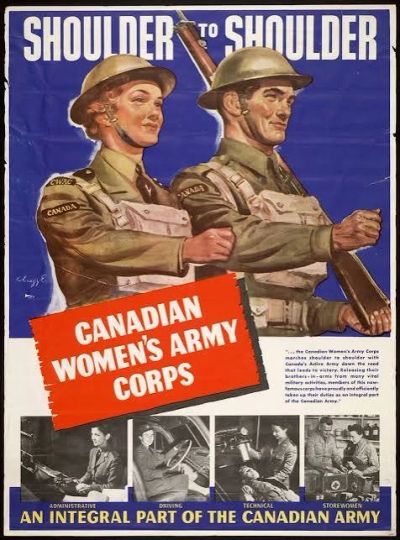
Established on August 13, 1941, as a historic, non-combatant branch of the Canadian Army designed to release men from administrative and support roles for front-line combat during World War II. Operating under the prominent motto "We serve that men may fight," the CWAC marked the first time in Canadian history that women were mobilized for military service in roles outside of traditional military nursing By the end of hostilities, the corps reached roughly 21,000 members. Women started in traditional roles like cooking and tailoring, but later drove trucks and ambulances, worked as mechanics, and decoded secret messages at top-secret sites like Camp X.
RCAF Women’s Division (RCAF-WD)
Formed on July 2, 1941 RCAF-WD started as the Canadian Women's Auxiliary Air Force (CWAAF), renamed in February 1942. They were a World War II non-combatant branch initially designed to replace male personnel in clerical and administrative roles before expanding to 69 different trades including mechanics, parachute riggers, and wireless operators. Over 17,000 women served in the RCAF-WD during the war. Their slogan was "We serve that men may fly,"
Women’s Royal Canadian Naval Service (WRCNS / "Wrens")
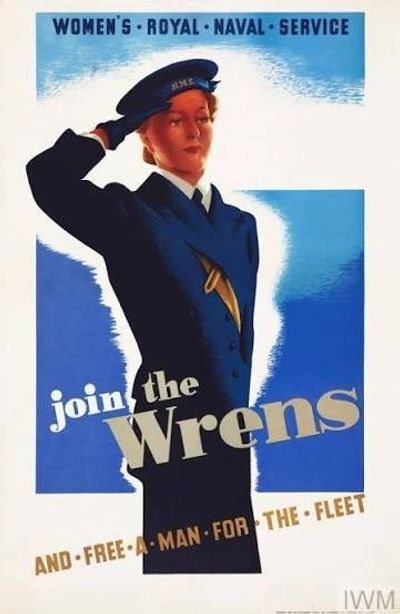
The navy was the last service to create a women’s division. The Women’s Royal Canadian Naval Service (WRCNS) was founded in July 1942. It was patterned on the British Women’s Royal Navy Service (WRNS). The term “Wrens,” by which WRCNS members were known, was the logical slurring of the British WRNS. Indeed, with no existing Canadian naval model, the WRCNS closely followed the British example, with initial senior leadership positions filled by British Wrens on loan. Unlike the WRNS, however, it was an integral part of the RCN, not an auxiliary service.