

World war ii casualties
We are currently building our World War II remembrances.
We are looking for photographs of the following individuals who perished in service with the Canadian Merchant Marine:
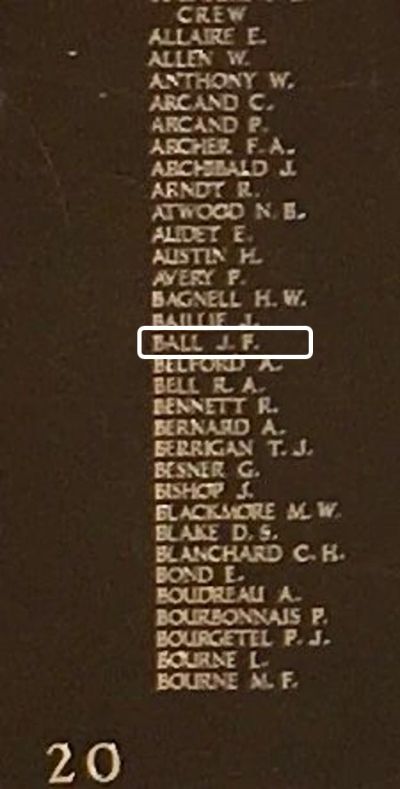
Fireman John Franklin (Jack) Ball
Fireman Walter Brackenbury
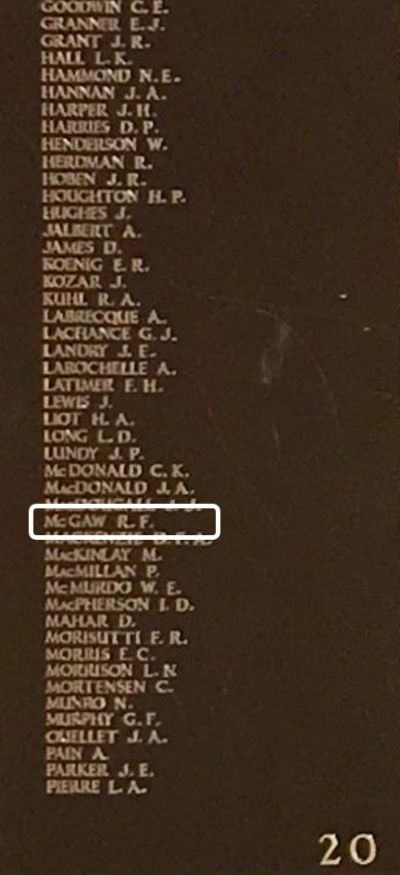
Third Engineer Robert F. McGaw
John Franklin (Jack) Ball
John Franklin (Jack) Ball was born on December 13, 1913 in Port Stanley, Elgin County. His parents were Philo John Ball and Olivia Grace West. Jack was the third of nine children listed on the 1931 Canadian Census.
Jack Ball was a member of the Canadian Merchant Navy. He initially served as a Fireman on the tanker SS Trontolite before being transferred to the M.V. Victolite.
At 03:28 hours on Feb. 11, 1942 the unescorted Victolite was hit amidships by one torpedo from U-564 about 260 miles north-northwest of Bermuda. The U-boat had first spotted the tanker seven hours earlier and missed with a first torpedo at 01:43 hours. The Germans observed how the crew abandoned ship in the lifeboats, identified the vessel from her distress signals and then began to shell the Victolite for a short time to ascertain that everyone had left. A boarding party in a rubber dinghy went to the abandoned tanker to search for secret documents and diesel oil that could be used to refuel the U-boat, but all safes were open and empty and the fuel found was unsuitable as it was too viscous. The boarding party left after placing four scuttling charges in the engine room. However, the ship still remained afloat after the explosions and U-564 began to shell her again. At 06:05 hours, the U-boat left the completely burning wreck behind after firing 98 rounds from the deck gun into the tanks and the superstructure.
Those who had abandoned the Victolite were never found: the master, 44 crew members and two gunners were lost.
Fireman Jack Ball has been committed to the sea . He is remembered by Canada at the HALIFAX MEMORIAL in Nova Scotia's capital, erected in Point Pleasant Park, is one of the few tangible reminders of the men who died at sea. Twenty-four ships were lost by the Royal Canadian Navy in the Second World War and nearly 2,000 members of the RCN lost their lives. The monument is a great granite Cross of Sacrifice over 12 metres high, clearly visible to all ships approaching Halifax. The cross is mounted on a large podium bearing 23 bronze panels upon which are inscribed the names of over 3,000 Canadian men and women who were buried at sea. Fireman Jack Ball is listed on Panel 20.
Lest We Forget
We have been unable to uncover a photograph of John Franklin (Jack) Ball in spite of some lengthy research. If any members of the Ball family have a photograph they would like to share, please let us know at pbhistoricalsociety@gmail.comso we can update our tribute to Fireman Ball.
Walter Brackenbury
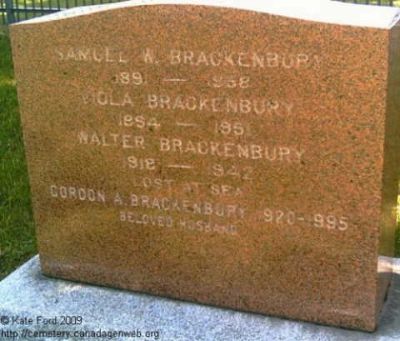
Walter Brackenbury was born on 1918, in Malahide, Ontario, to Samuel Walter Brackenbury and Eva Viola Wilson. He had one younger brother, Gordon.
During World War II, Fireman/Wiper Walter Brackenbury was serving in the Canadian Merchant Navy aboard the S.S. Ramapo (Panama).
Completed in 1924 in Scotland, the 2,968-ton vessel Ramapo was owned by the Waterman Steamship Co. of Mobile, Alabama. During World War II, she operated with an international merchant crew. On February 16, 1942, she was torpedoed and sunk by the German U-boat U-108 northwest of Bermuda. Her boilers exploded, the ship split in two, and tragically, Walter Brackenbury along with another 37 crew members were lost.
Third Engineer Walter Brackenbury has been committed to the sea. He is remembered by Canada at the HALIFAX MEMORIAL in Nova Scotia's capital, erected in Point Pleasant Park, is one of the few tangible reminders of the men who died at sea. Twenty-four ships were lost by the Royal Canadian Navy in the Second World War and nearly 2,000 members of the RCN lost their lives. The monument is a great granite Cross of Sacrifice over 12 metres high, clearly visible to all ships approaching Halifax. The cross is mounted on a large podium bearing 23 bronze panels upon which are inscribed the names of over 3,000 Canadian men and women who were buried at sea.
Lest We Forget
We have been unable to uncover a photograph of Walter Brackenbury in spite of some lengthy research. If any members of the Brackenbury family have a photograph they would like to share, please let us know at pbhistoricalsociety@gmail.comso we can update our tribute to Fireman Walter Brackenbury.
Robert McGaw
Robert McGaw was born on January 27, 1906, in Port Burwell, Ontario, to Peter McCaw and Mary Elizabeth Chivers. He had six brothers (Claude Elmer, John Henry, Howard Russell, Willam Albert, Harold Carleton and Clayton Lewis) and one sister (Ethel Viola).
During World War II, Third Engineer Robert McGaw was serving in the Canadian Merchant Navy aboard the S.S. Carolus (Canada).
On 9 October 1942, at 6.07 am, the Carolus while traveling from Goose Bay, Newfoundland, to Montreal as part of Convoy NL-9 was torpedoed and sunk by U-69 in the Gulf of St Lawrence, opposite Bic Island, Quebec, position 48°47'N/68°10'W. Eleven crew members lost their lives and the 19 survivors were rescued by HMCS Hepatica (K159) and HMCS Arrowhead (K145). Third Engineer Robert McGaw was one of the eleven lost crew.
Third Engineer Robert McGaw has been committed to the sea. He is remembered by Canada at the HALIFAX MEMORIAL in Nova Scotia's capital, erected in Point Pleasant Park, is one of the few tangible reminders of the men who died at sea. Twenty-four ships were lost by the Royal Canadian Navy in the Second World War and nearly 2,000 members of the RCN lost their lives. The monument is a great granite Cross of Sacrifice over 12 metres high, clearly visible to all ships approaching Halifax. The cross is mounted on a large podium bearing 23 bronze panels upon which are inscribed the names of over 3,000 Canadian men and women who were buried at sea. Third Engineer Robert McGaw is listed on Panel 20.
Lest We Forget
We have been unable to uncover a photograph of Robert McGaw in spite of some lengthy research. If any members of the McGaw family have a photograph they would like to share, please let us know at pbhistoricalsociety@gmail.comso we can update our tribute to Third Engineer Robert McGaw.
John Temple Meyer
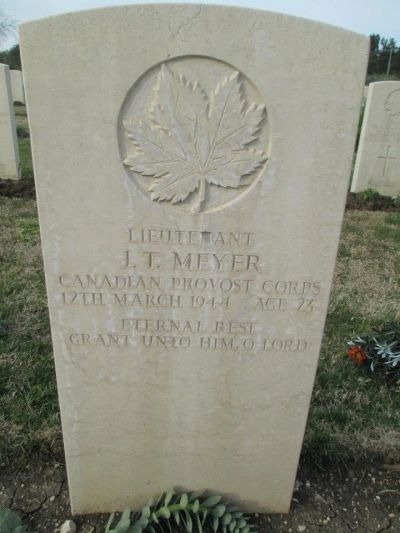
John Temple Meyer was born Jun 5th, 1920. Port Burwell, Elgin County, Ontario. His parents were Roy Stanley Meyer and Cora Ann Meyer, of Port Burwell, Ontario. According to the 1921 Canadian Census, John had two older sisters; Ruth and Margaret.
John Meyer joined the Canadian Army shortly after war was declared. He enlisted in London on September 15th, 1939 as a Trooper in the First Hussars. At the time of his enlistment, John Meyer was single and working as a truck driver and mechanic.
After initial training with the Hussars, Tpr. Meyer was posted to the 3rd Company, Provost Corp on June 6th, 1940. Shortly after, on June 8th, they embarked out of Halifax for the European Theatre, arriving in Liverpool on the 23rd.
While stationed in England, John Meyer began moving up through the ranks; Lance Corporal on July 1st, 1940, Corporal on February 12th, 1941, Acting Sergeant on May 8th, 1942, Sergeant on August 8th, 1942.
Sgt Meyer’s unit proceeded overseas on September 13th, 1943 to join the Canadian Army actively engaged in the Italian Campaign. While in Italy, John Meyer was promoted to Lieutenant on November 6th, 1942.
On December 28, 1943, Canadian troops liberated the Italian town of Ortona after eight days of brutal street fighting in the Battle of Ortona, which took place along the Moro River. After the Battle of Ortona, the Canadian forces were deployed a short distance to the north along the Arielli River holding positions during the harsh Italian winter freeze.
It was during this time, on March 8th, 1944, that Lieutenant John Meyer was wounded in his right leg by artillery fire and suffered severe hemorrhaging. He later died of his wounds on March 12th, 1944.
During his time in Italy, Lt. Meyer was Mentioned in Dispatches in recognition for gallant and distinguished service and received a posthumous citation from King George VI
He is buried at the Moro River Canadian War Cemetery and his gravesite reference is VI. D. 8.
Lest We Forget
Ernest Gusieppe Monaco
Ernest Gusieppe Monaco was born September 2nd, 1925 in Coseanno, Italy. The youngest of four children, Ernest Monaco came to Canada when he was nice years old with his parents Luigi and Adella and settled in Port Burwell. An older brother and sister remained behind in Italy. Another brother came with the family to Canada.
Ernest Monaco enlisted in Toronto on March 28th, 1944. At the time of his enlistment, Ernest Monaco was single and working as a machine operator with the Otis Elevator Company.
Because of his Italian heritage, Ernest Monaco underwent a vetting process to ensure he was a Naturalized Citizen with no concerning ties to his homeland.
Pte. Monaco struggled with his training having to receive additional training to complete both basic and Advanced Training courses. Judged to be “… an average, well adjusted soldier…[he] is a sleepy individual who does not try and is always lagging back.”
Pte. Monaco shipped out on October 4th, 1944 and landed in England on the 11th. He was assigned to the Argyll & Sutherland Highlanders of Canada on November 2nd, 1944.
From February 26th – March 3rd, 1945 the Argylls were part of Operation Blockbuster and were engaged in some of the bloodiest fighting of World War II during the Battle of the Hochwald Gap. By February 28, the Argylls had pushed into exposed forward positions inside the gap, facing intense, concentrated German mortar, artillery, and small-arms fire from elite German paratroopers (Fallschirmjäger). During the brutal fighting, the Argylls' B Company became completely cut off and isolated by enemy forces. At noon on February 28, the Lincoln and Welland Regiment launched a two-pronged counter-attack through a fierce artillery barrage to reinforce the Argylls and successfully rescue the trapped B Company.
It was during this intense encounter that Private Ernest Gusieppe Monaco was Killed In Action on February 28th, 1945.
Private Ernest Gusieppe Monaco is buried in Holland at the Nijmegen Canadian Military Cemetery, 4 miles southeast of Nijmegen, Netherlands.
Lest We Forget

LEONARD HARVEY PALMER
Born on December 31st, 1919, Leonard Harvey Palmer was the son of Phillip and Mary Elizabeth Palmer of Eden, Ontario. He had two brothers, Philip (RCAF stationed in England) and Douglas. He also had one sister, Kathleen May (CWAC stationed in Halifax).
Leonard Palmer enlisted on October 4th, 1939. Working as a labourer on a tobacco farm owned by J.B. Kennedy of Straffordville, Ont. when he volunteered
Pte. Palmer was assigned to the Princess Patricia’s Canadian Light Infantry and sailed with the unit when they left Canada on December 21st, arriving in England on December 30th, the day before his 20thbirthday.
While stationed in England, Pte. Palmer, like many Canadian Soldiers, met a local lady and, on December 26th, 1942 became the husband of Marjorie Joan Palmer, of Whitney, Surrey, England.
Upon leaving England, Pte. Palmer and the Princess Patricia's Canadian Light Infantry (PPCLI) served with the 2nd Infantry Brigade, 1st Canadian Infantry Division, as part of the British Eighth Army in the Mediterranean. Their major actions were:
Sicily Campaign (Operation Husky)
- Landing: Landed in Sicily on July 10, 1943.
- First Battle Honour: Won its first WWII battle honour at Leonforte.
- Progression: Fought through harsh mountain terrain alongside units like the Loyal Edmonton Regiment before the campaign concluded in August 1943.
Italian Campaign
- Mainland Landing: Landed on the Italian mainland on September 4, 1943.
- Winter & Heavy Combat: Fought through bitter weather and German rear-guard actions, including the Moro River Campaign and street fighting in Ortona in December 1943.
- Key Breakthroughs: Participated in breaking the Hitler Line and Gustav Line in the Liri Valley (May 1944) and later fought along the Gothic Line and Romagna waterways.
It was during the later engagement, Pte. Palmer was detached from his unit to attend a Junior Leaders training course. On May 10, 1944, while undertaking weapons training, a mortar round exploded prematurely instantly killing Pte. Palmer and a L/Cpl Henry of the Carlton & York Regiment. A subsequent Board of Inquiry found neither of the individuals were negligent in their duties.
Private Leonard Harvey Palmer is interned in the Caserta War Cemetery (Grave Reference: VII, D, 7.) outside of Caserta, Italy.
Lest We Forget
We have been unable to uncover a photograph of Leonard Harvey Palmer in spite of some lengthy research. If any members of the Palmer family have a photograph they would like to share, please let us know at pbhistoricalsociety@gmail.comso we can update our tribute to Pte. Palmer.